Why both research and engineering?
PhilosophyMost HRI researchers use commercial robots. Most roboticists never study human interaction. I believe doing both leads to better science and better machines.
Working in both worlds changes how I design robots. As an HRI researcher, I know what actually matters in a study: repeatability, embodiment cues, real-time responsiveness, and participant comfort. Some performance problems never show up on a spec sheet; you only find them by watching a lot of people use the machine, and three years at the Link Lab gave me that sample.
As a roboticist, I engineer open-source, cheaper alternatives to commercial humanoid systems, designed specifically for HRI labs. Instead of imitating expensive telepresence robots, I build tools shaped by how research actually runs: easy to repair, modular, well documented, and able to survive multi-participant studies where hardware reliability matters more than polish.
So I can run a study, see what breaks in the hardware, and fix it before the next participant sits down. It's an uncommon workflow for a student. I've logged over 7,800 minutes of user testing across two custom-built systems, with one published paper and another in progress.
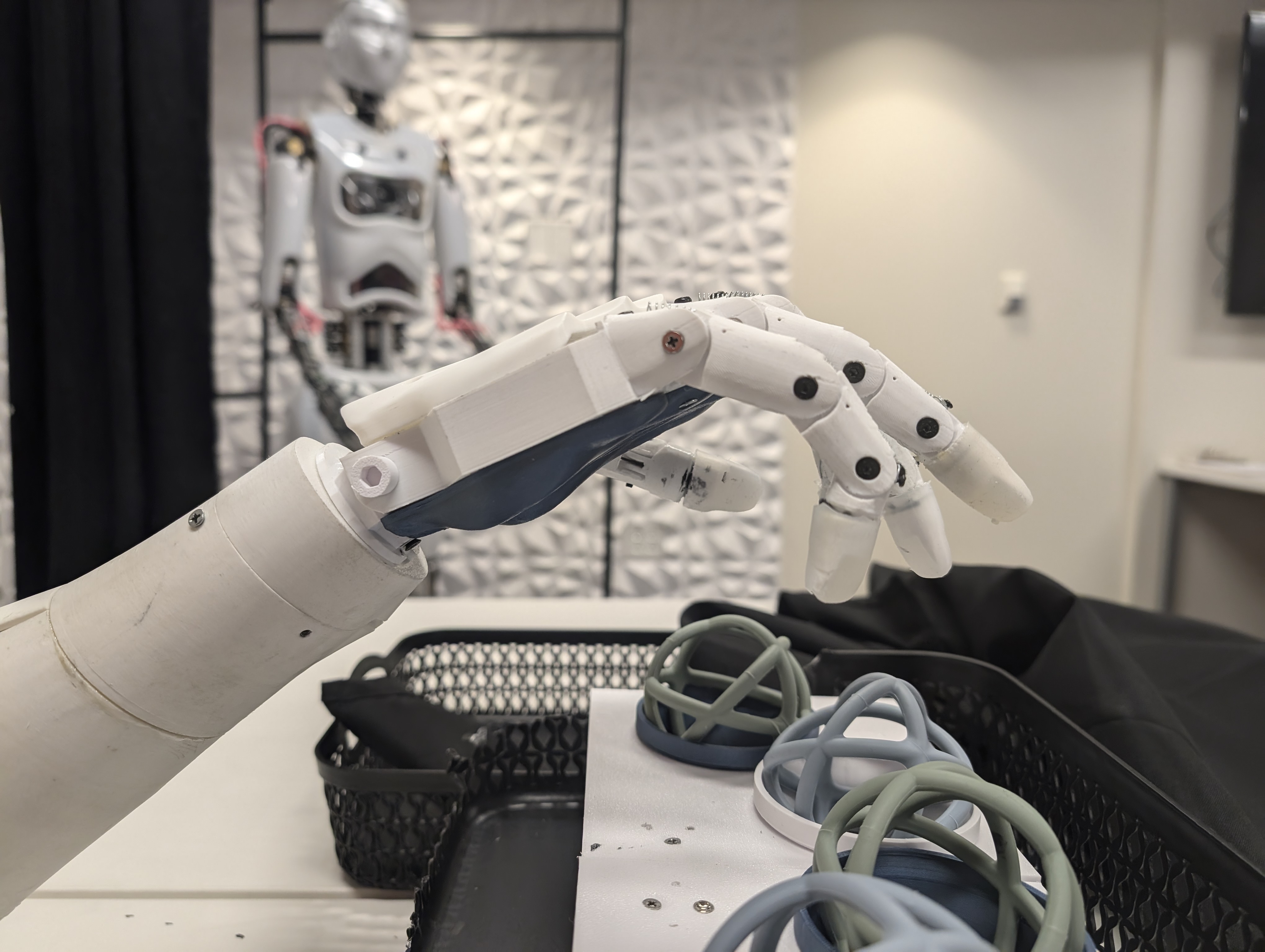 8-DOF HAND · MEDIAPIPE
Engineering projects
Hardware · Software · Deployment8-DoF Humanoid Hand
Real-time hand tracking teleoperation system with MediaPipe integration, deployed in a 4,500+ minute user study.
I designed and assembled an 8 degree-of-freedom humanoid hand for teleoperation research. The system uses Google MediaPipe for real-time hand tracking and maps operator hand poses to servo positions at 30+ fps with minimal latency.
The mechanical design prioritizes repairability and modularity: each finger is independently serviceable, with 3D-printed linkages and off-the-shelf servos. The embedded control runs on a Raspberry Pi, where a custom Python pipeline handles pose estimation, inverse kinematics, and servo control over serial.
I deployed it in a multi-week study on operator embodiment during teleoperation tasks. It survived 4,500+ minutes of continuous user testing with minimal hardware failures.
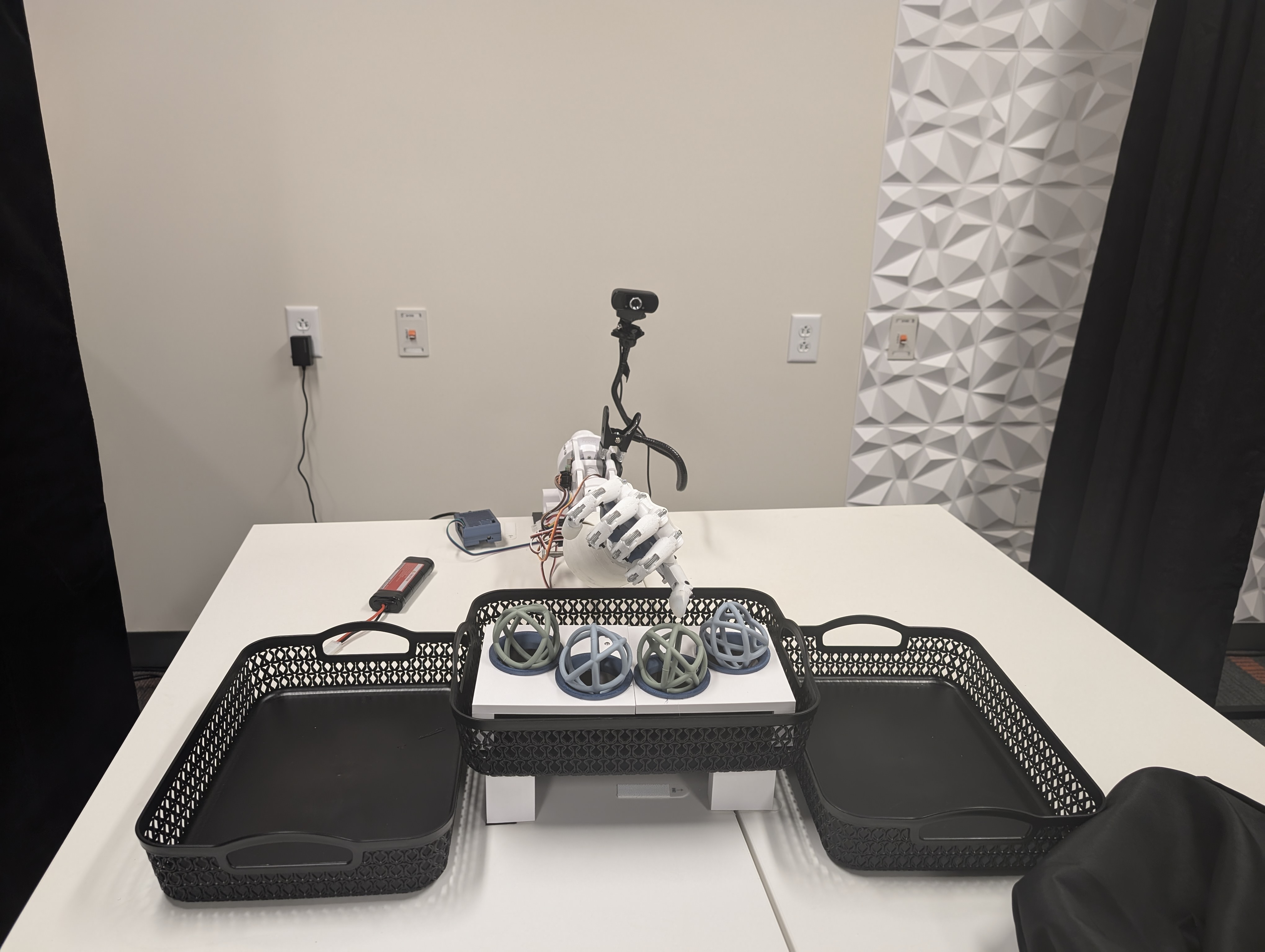 STUDY SETUP
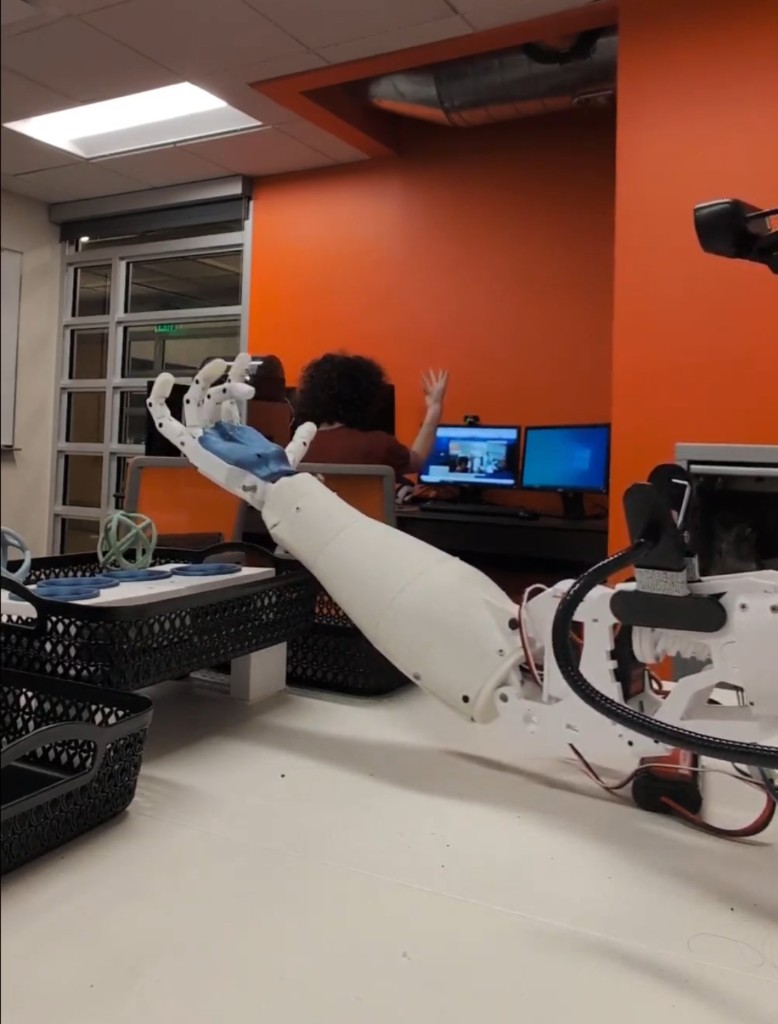 IN ACTION
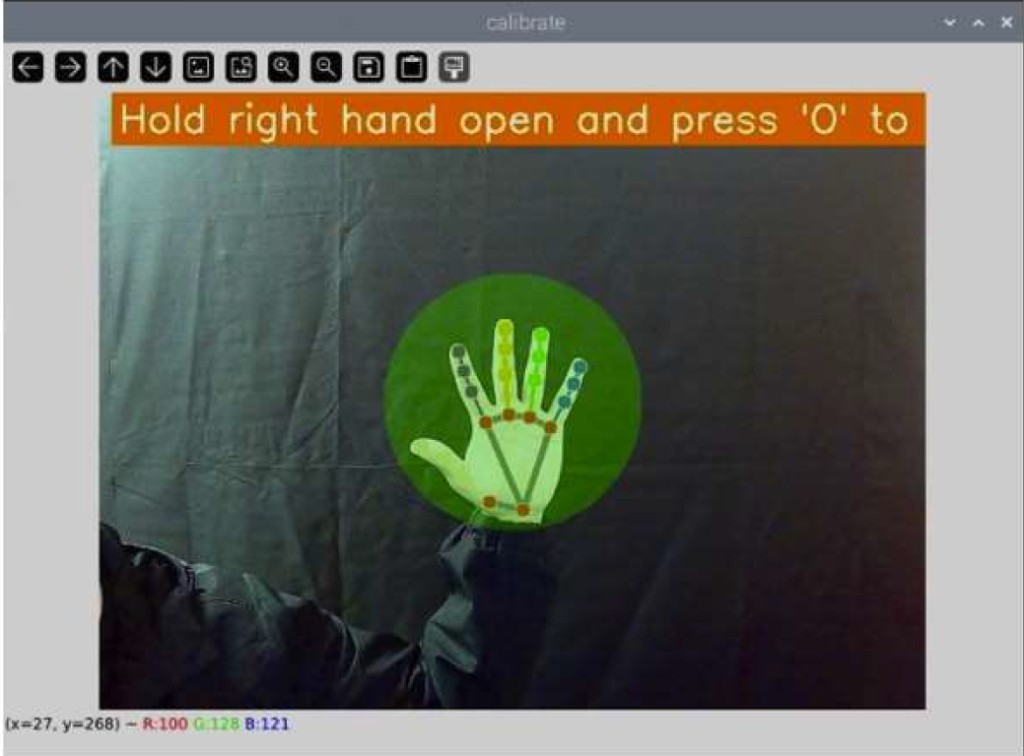 MEDIAPIPE OVERLAY
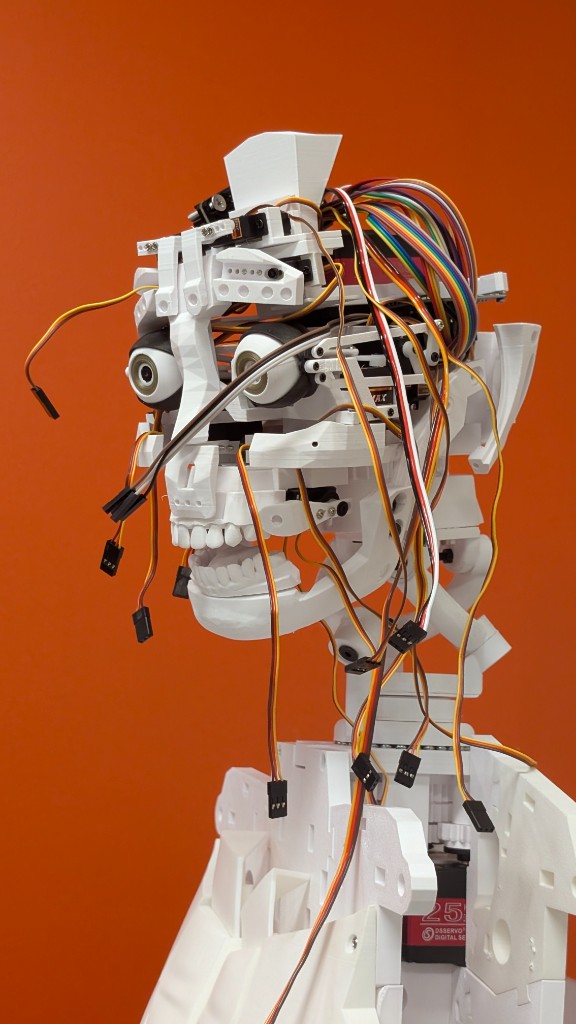 HEAD SYSTEM · 16-DOF
16-DoF Humanoid Robotic Head
Soft-face humanoid head with real-time facial expression teleoperation using FPENet, deployed in a 3,300+ minute facial mimicry study.
A 16 degree-of-freedom humanoid head with a soft silicone face, built for researching facial mimicry and presence in social teleoperation. A custom pipeline around NVIDIA's FPENet facial-landmark model runs on a Jetson and does the facial tracking and expression transfer in real time.
Mechanically, servo-driven linkages sit beneath a compliant silicone skin, which is what lets the face form naturalistic expressions. The control architecture maps detected facial landmarks to servo positions through a learned inverse kinematics model trained on thousands of expression samples.
The mechanical design, embedded software, computer vision pipeline, and facial actuation mapping are all my work. I deployed the system in a 3,300+ minute user study on how facial teleoperation affects operator presence and participant perception in social HRI scenarios.
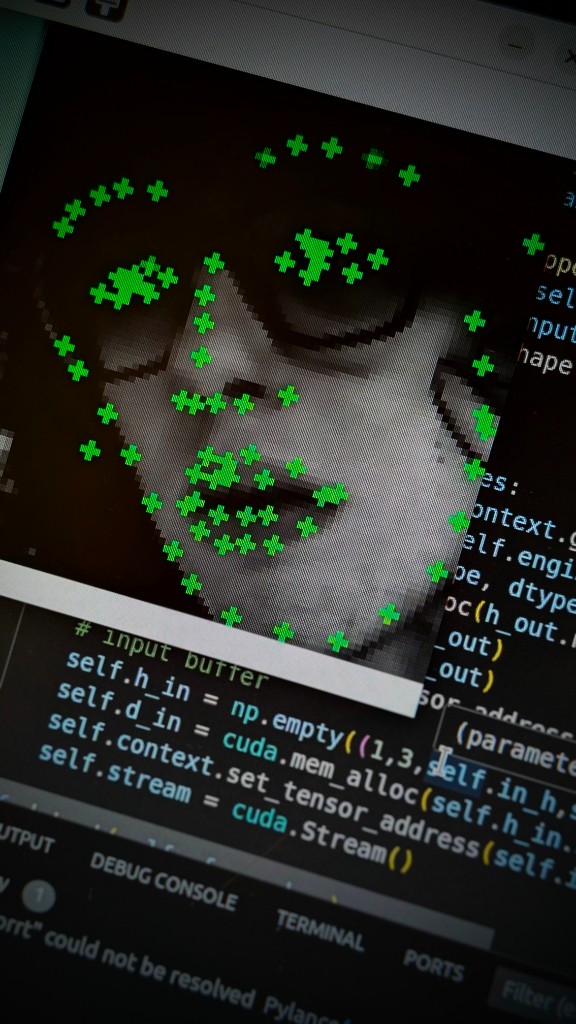 FPENET TRACKING
Combined user testing across both systems with 250+ participants in controlled HRI studies
8-DoF hand + 16-DoF head, enough articulation to teleoperate gesture and expression together
Designed, assembled, and coded entirely by me: CAD, control loops, and computer vision
HRI research contributions
Publications · Ongoing workPublished: TARX Scale Validation
Co-authored paper presenting the initial validation of TARX, the Teleoperator-Avatar Robot Interaction scale for measuring operator-robot relationships in teleoperation.
TARX adapts player-avatar relationship theory to teleoperation: a psychometric scale measuring the operator's relationship with the robot along four dimensions (relational closeness, anthropomorphic autonomy, critical concern, and sense of control). In the validation study, participants remote-controlled a robotic arm while we examined how embodied control shaped those dimensions.
The paper was published at HICSS 2025. The scale gives HRI researchers a validated way to measure the operator-robot relationship.
Teleoperator-Avatar Robot
Interaction Scale (TARX)
on System Sciences
in Social Teleoperation
for publication
Ongoing: Facial Mimicry Study
A study of how real-time facial expression teleoperation affects operator presence and participant perception in social HRI scenarios.
The study asks whether facial mimicry in a teleoperated humanoid improves social presence and interaction quality in human-robot conversations. Participants worked through structured social tasks with the 16-DoF head while FPENet tracking mirrored the operator's facial expressions in real time.
There are three conditions: full facial teleoperation, static neutral expression, and no face. Preliminary findings suggest real-time facial mimicry significantly increases perceived presence and social engagement, though the picture is complicated by uncanny valley effects and operator cognitive load.
I'm writing the work up for submission to a major HRI conference, drawing on the 3,300+ minutes of user testing data, both quantitative and qualitative.